





1st November 2026
Fertility
Follow the latest news and developments in the world of fertility.
< View all our fertility news and posts


Men across the East of England take prescribed testosterone therapies at higher rates than anywhere else in the country, but nearly six in ten have no idea the treatments can directly damage male fertility.
One in 20 men (5%) in the region have used prescribed testosterone replacement therapy (TRT), a hormone treatment to boost low testosterone levels, in the past six months. That is nearly double the rate seen in London (2.9%) and well above the 3.3% UK average.
The figures come from a new OnePoll study1 of 2,000 males aged 18 to 40, commissioned by Herts & Essex Fertility Centre.
Timed for Men’s Health Awareness Month and National Fertility Awareness Week (2–6 November), the research reveals that an estimated 600,000 British men are currently2 taking hormone medications that shut down natural sperm production.
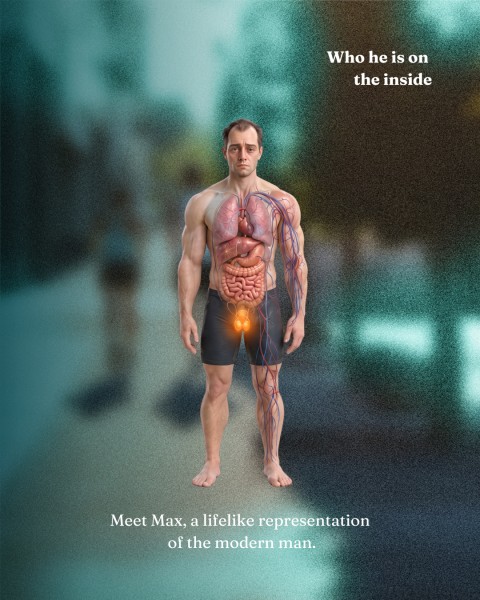
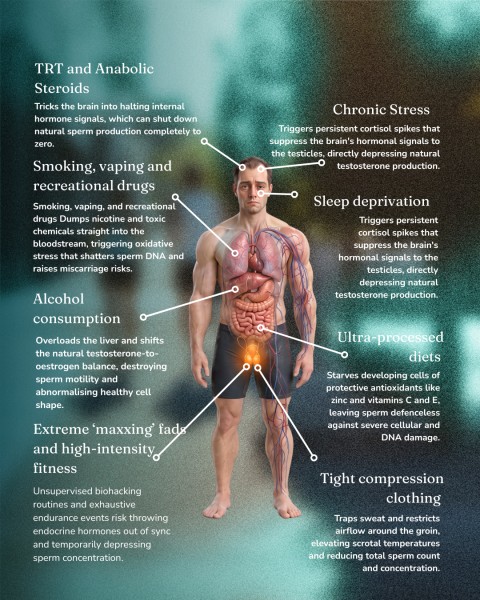
The findings raise concerns about the fertility risks of ‘health-maxxing’, as some men pursue physical performance, muscle growth and hormone optimisation without understanding how certain substances stop sperm production.
Just 43.3% of men in the East of England recognise that TRT or anabolic steroids damage sperm count, leaving nearly six in ten (56.7%) completely unaware of the risks.
Among active users of TRT or anabolic steroids, the lack of knowledge is alarming: Nationally, one in three (33.3%) had zero awareness that external testosterone can reduce their sperm count to zero. Even knowing the risks doesn’t deter some: more than a quarter (27.8%) of those who knew the dangers admitted they just don’t care.
Beyond hormone therapies, men in the East are equally in the dark about everyday lifestyle threats. Nearly six in ten (58.2%) have no idea vaping can harm sperm, second only to London as the least-aware region in England even though 30% vape regularly. Another 36% do not know cigarettes damage fertility, and 31% fail to link heavy drinking to falling sperm counts.
The findings expose a dangerous disconnect: men are working hard to look fit on the outside, but their daily habits are quietly wrecking their sperm on the inside.
Despite these fertility threats, four in ten (40%) men in the East of England admit they’d never previously considered their own sperm health, even though 88% believe investigating fertility issues should be a shared responsibility between partners.
The research also reveals that men feel the stigma of infertility and are reluctant to open up. More than seven in 10 (71.4%) wouldn’t feel comfortable talking to their GP about it if they discovered a fertility issue (only 28.6% would tell a doctor compared to 36.2% nationally).
While over half (54%) would confide in their partner, nearly one in five (19.4%) would turn to a brother or sister – the highest rate in England and more than three times higher than the East Midlands (5.9%) and well above the UK average (14.1%).
An abnormal test hits men hard: four in 10 in the East (40%) expect low mood, while 27% fear reduced self-esteem and 27% expect serious relationship strain.
Banter only deepens the silence. More than a third of UK men (35.9%) can’t count on their friends for support, and one in nine (11.0%) expect outright mockery from their mates. That stigma explains why men keep quiet: Over 71% of local men avoid their GP, 45.4% would conceal a diagnosis from the person they are trying to have a baby with, and 7.2% of men (roughly 1 in 14) admit they would consider walking away from their partner entirely out of shame.
Across the UK, the psychological toll is especially severe among younger men: 1 in 11 men aged 18 to 25 (9.1%) say discovering a fertility problem would trigger suicidal thoughts (note: Anyone affected by these issues can contact Samaritans free on 116 123 or visit samaritans.org.)
Too embarrassed to see a GP, men in the East are also turning to Dr ChatGPT in secret. More than a third of men across the UK (36.6%) search Google for fertility advice and nearly one in four (22.6%) ask AI bots, rising to 37% among hopeful fathers who risk bad internet advice over proven medical facts.
The report highlights a simple fix to give men more information to make changes. More than three quarters of men in the East (77.3%) admit they would happily take a sperm test if it was treated like a standard gym stat like body fat percentage, rather than an emergency doctor’s appointment.
It is not just lifestyle habits catching men out – it’s also age. More than four in 10 men in the East (44.0%) think their sperm stays fertile forever, prompting almost half (49.0%) to consider freezing their sperm as backup.
A glance: how the East of England compares nationally
| Reproductive health metric / habit | East of England | London | South West | UK Average |
| Prescribed TRT uptake (past six months) | 5.0% (highest in England) | 2.9% | 3.9% | 3.3% |
| Steroid & TRT fertility impact ignorance | 56.7% | 58.7% | 58.8% | 50.9% |
| Vaping risk awareness | 41.8% | 37.5% | 51.6% | 45.3% |
| Smoking risk awareness | 63.8% | 65.4% | 75.2% | 67.9% |
| Alcohol risk awareness | 68.8% | 61.6% | 74.5% | 68.9% |
| Intense exercise risk awareness | 23.4% | 18.6% | 23.5% | 20.1% |
| Would confide in GP | 28.6% | 29.4% | 36.2% | 36.2% |
| Would confide in a sibling | 19.4% (highest in England) | 12.6% | 14.0% | 14.1% |
| Willingness to test sperm if framed as fitness | 77.3% | 74.4% | 75.5% | 75.5% |
| Would consider freezing sperm for the future | 49.0% | 43% | 43% | 43.0% |

Mr David Ogutu, medical director at Herts & Essex Fertility Centre, said:
“Many men invest considerable effort in optimising their physical fitness and performance, often without realising that some practices may compromise their fertility.
“Testosterone supplementation and anabolic steroid use can suppress the body’s natural hormone production, significantly reducing sperm counts or even stopping sperm production altogether. Excessive heat exposure and extreme dieting may also adversely affect sperm quality. Unfortunately, these effects often go unnoticed until a couple has trouble conceiving, sometimes after many months of trying unsuccessfully.
“Male fertility should be assessed from the outset of family planning, alongside female reproductive health, and certainly as soon as a couple experiences difficulty conceiving. It should not be an afterthought, following months of investigations focused solely on the woman. A simple semen analysis can help identify potential problems early. Fertility is a shared responsibility, and men should feel just as comfortable assessing their reproductive health as women do.”
About the research
The omnibus research was commissioned by Herts & Essex Fertility Centre in partnership with Examen and conducted by independent market research agency, OnePoll. The survey polled a nationally representative sample of 2,000 UK males aged 18 to 40 between 2 October and 8 October 2026. Data was weighted across age, region, and relationship status to reflect national census profiles. All statistics and sub-sample analyses are derived directly from the primary dataset.
Media contacts & patient stories:
For clinical interviews with Mr David Ogutu at Herts & Essex Fertility Centre, contact Michelle Ivins at CJM PR on 07930 743990 – michelle@cjmpr.co.uk or Natalie Merrix at CJM PR: 07817146333 – natalie@cjmpr.co.uk
About Herts & Essex Fertility Centre
Founded in 1989 and based in Cheshunt, Hertfordshire, Herts & Essex Fertility Centre is one of the UK’s most established and successful fertility clinics. Renowned for its exceptional success rates and compassionate, patient-centric care, the clinic has helped deliver over 6,000 babies through personalised treatment plans, including IVF, ICSI, egg freezing, and donor programmes. In 2026, Herts & Essex became part of the FutureLife Group, further strengthening its clinical expertise and access to cutting-edge reproductive science.
Herts & Essex Fertility Clinic consistently ranks among the top IVF clinics in the UK for success rates through the HFEA.
About FutureLife
FutureLife is one of Europe’s leading providers of IVF and genetics services, with a widespread presence across multiple countries. The group is dedicated to providing the highest standards of clinical care, utilising advanced scientific research and technology to improve global success rates in reproductive medicine.
NEXT/PREVIOUS:


